
VA Ethics Panels: Where Complaints Against State Lawmakers Go to Die
Part 2 of a series on Virginia's ethics laws concerns the Senate and House Ethics Panels and the fate of complaints against members of the Virginia General Assembly.
In my first installment of a series focused on enforcement of Virginia’s ethics laws, I delved into the inaccessible process by which citizens can file ethics complaints against members of the Virginia General Assembly. Let’s now assume a citizen figures out how to file a complaint with the Virginia Conflict of Interest and Ethics Advisory Council — what happens next?

The Complaint Process by Law
According to Va. Code § 30-114, the Council then sends the complaint to the legislator named and to the chair of either the Senate or House Ethics Advisory Panel to investigate. The members of these panels are chosen by the corresponding bodies of the General Assembly and serve for four-year terms pursuant to Va. Code § 30-112. The Panels also have subpoena power.
Va. Code § 30-116 governs how the panels deal with an ethics complaint:
Within 120 days of the chairman's forwarding the signed and sworn complaint to the Panel, the Panel, or a majority of its members acting in its name, shall dispose of the matter in one of the following ways:
1. a. If the Panel determines in its preliminary investigation that the complaint is without merit, the Panel shall dismiss the complaint, so advise the complainant and legislator, and take no further action. In such case, the Panel shall retain its records and findings in confidence unless the legislator under inquiry requests in writing that the records and findings be made public.
b. If the Panel determines in the course of its proceedings that the facts and evidence show that the complaint is without merit, the Panel shall dismiss the complaint, so advise the complainant and legislator, and report its action to the Clerk of the appropriate house, for the information of the House or Senate.
2. If the Panel determines that there is a reasonable basis to conclude that the legislator has violated the provisions of this chapter but that the violation was not made knowingly, the Panel shall refer the matter by a written report setting forth its findings and the reasons therefor to the appropriate house of the General Assembly for appropriate action. All Panel reports, which are advisory only, shall be delivered to the Clerk of the appropriate house, who shall refer the report to the Committee on Privileges and Elections in accordance with the rules of the appropriate house. Said Committee shall in all cases report, after due hearings and consideration, its determination of the matter and its recommendations and reasons for its resolves to the appropriate house. If the Committee deems disciplinary action warranted, it shall report a resolution to express such action. The appropriate house as a whole shall then consider the resolution, and if it finds the legislator in violation of any provision of this chapter, it may by recorded vote take such disciplinary action as it deems warranted.
3. If the Panel determines that there is a reasonable basis to conclude that the legislator knowingly violated any provision of Article 2 (§ 30-102 et seq.), 3 (§ 30-104 et seq.), 4 (§ 30-107 et seq.) or 5 (§ 30-109 et seq.) of this chapter, except § 30-108 or subsection C of § 30-110, it shall refer the matter by a written report setting forth its findings and the reasons therefor to the Attorney General for such action he deems appropriate. The Panel shall also file its report with the Clerk of the appropriate house, who shall refer the report in accordance with the rules of his house. In the event the Attorney General determines not to prosecute the alleged violation, he shall notify the Clerk of the appropriate house of his determination and the Clerk shall send the report to the Committee on Privileges and Elections. The matter shall thereafter be handled in accordance with the provisions of subdivision 2.
4. If the Panel determines that there is a reasonable basis to conclude that the legislator has violated § 30-108 or subsection C of § 30-110, it shall refer the matter by a written report to the appropriate house pursuant to subdivision 2. As its first order of business other than organizational matters and committee work, the house in which the member sits shall immediately upon the convening of the next regular or special session take up and dispose of the matter by taking one or more of the following actions: (i) dismiss the complaint; (ii) sustain the complaint and reprimand the member; (iii) sustain the complaint, censure the member, and strip the member of his seniority; (iv) sustain the complaint and expel the member by a two-thirds vote of the elected members; (v) in the event the house finds a knowing violation, it shall refer the matter to the Attorney General pursuant to subdivision 3.
5. The Panel shall make public any report that it makes pursuant to the provisions of subdivision 1 b, 2, 3 or 4 on the date it refers its report.
The Attorney General & The Clerks
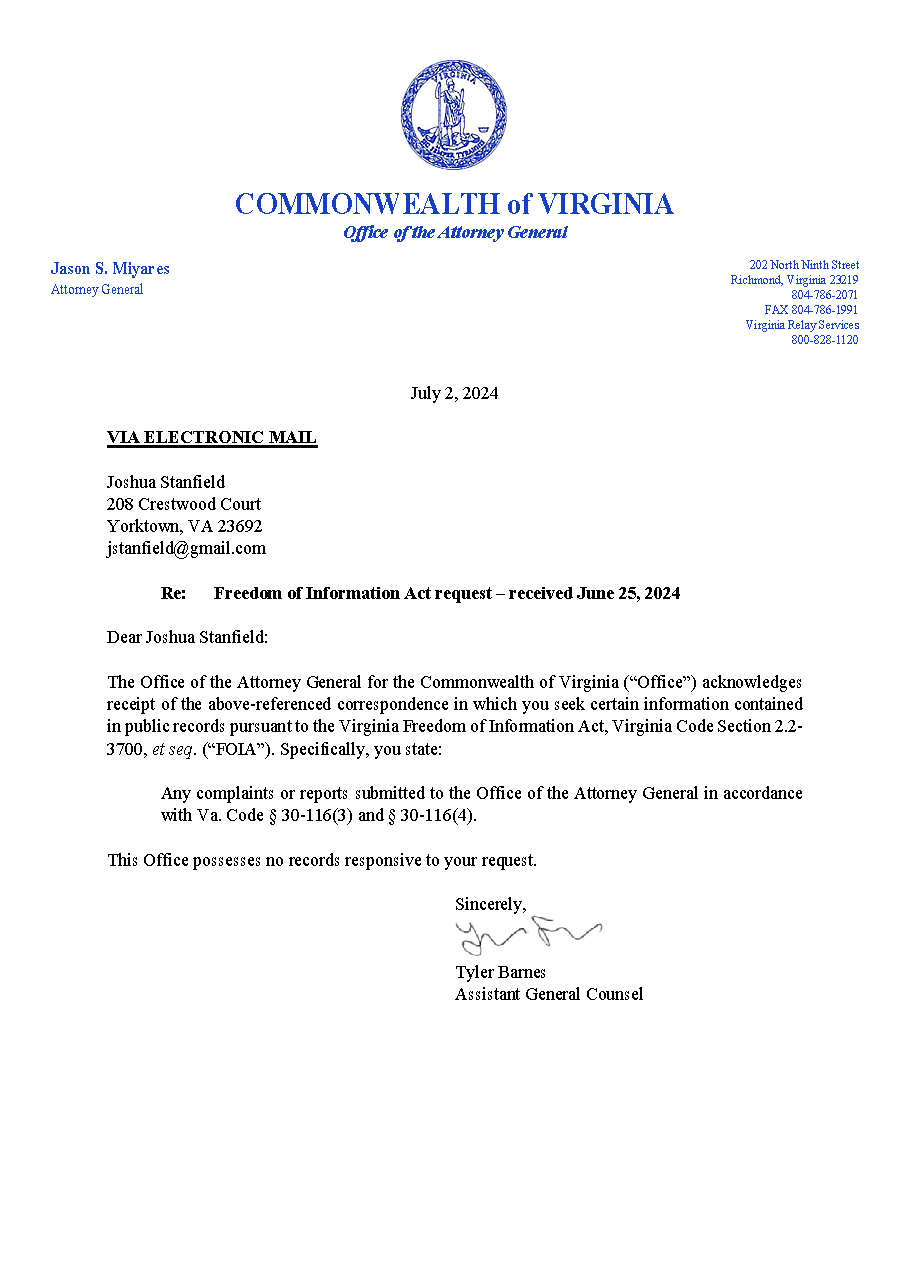
Let’s start with the most serious situation: have the Panels ever referred a complaint to the Office of the Attorney General for action? On June 25, 2024, I sent a FOIA request to the OAG seeking “[a]ny complaints or reports submitted to the Office of the Attorney General in accordance with Va. Code § 30-116(3) and § 30-116(4).”
On July 2, 2024, the OAG replied: “This office possesses no records responsive to your request.”
But have the Panels, concluding with a reasonable basis that a legislator has unknowingly violated the law, ever referred a complaint to the Senate Clerk or House Clerk?
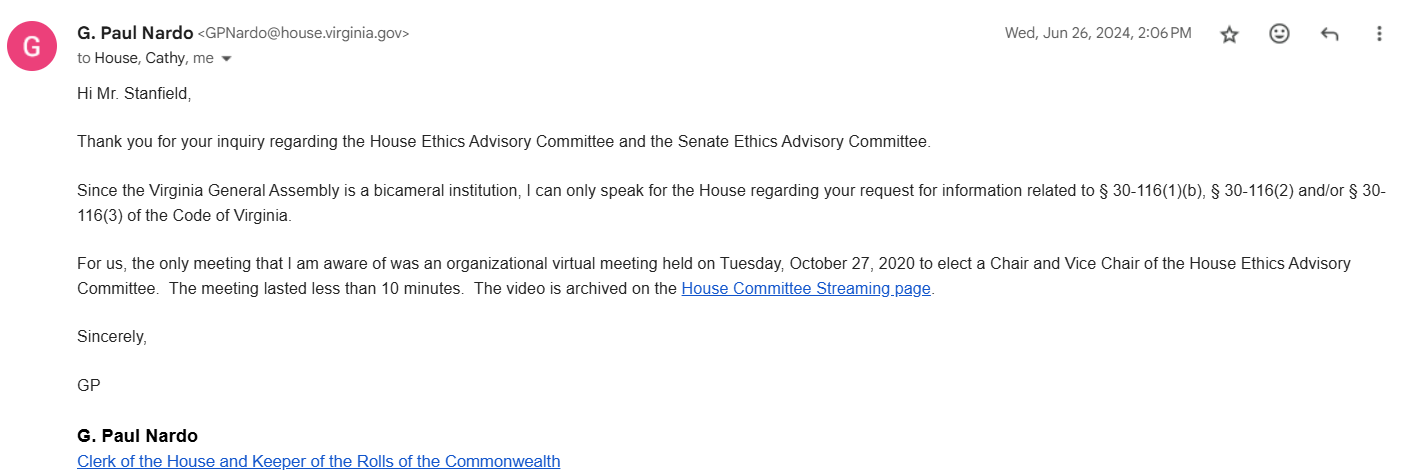
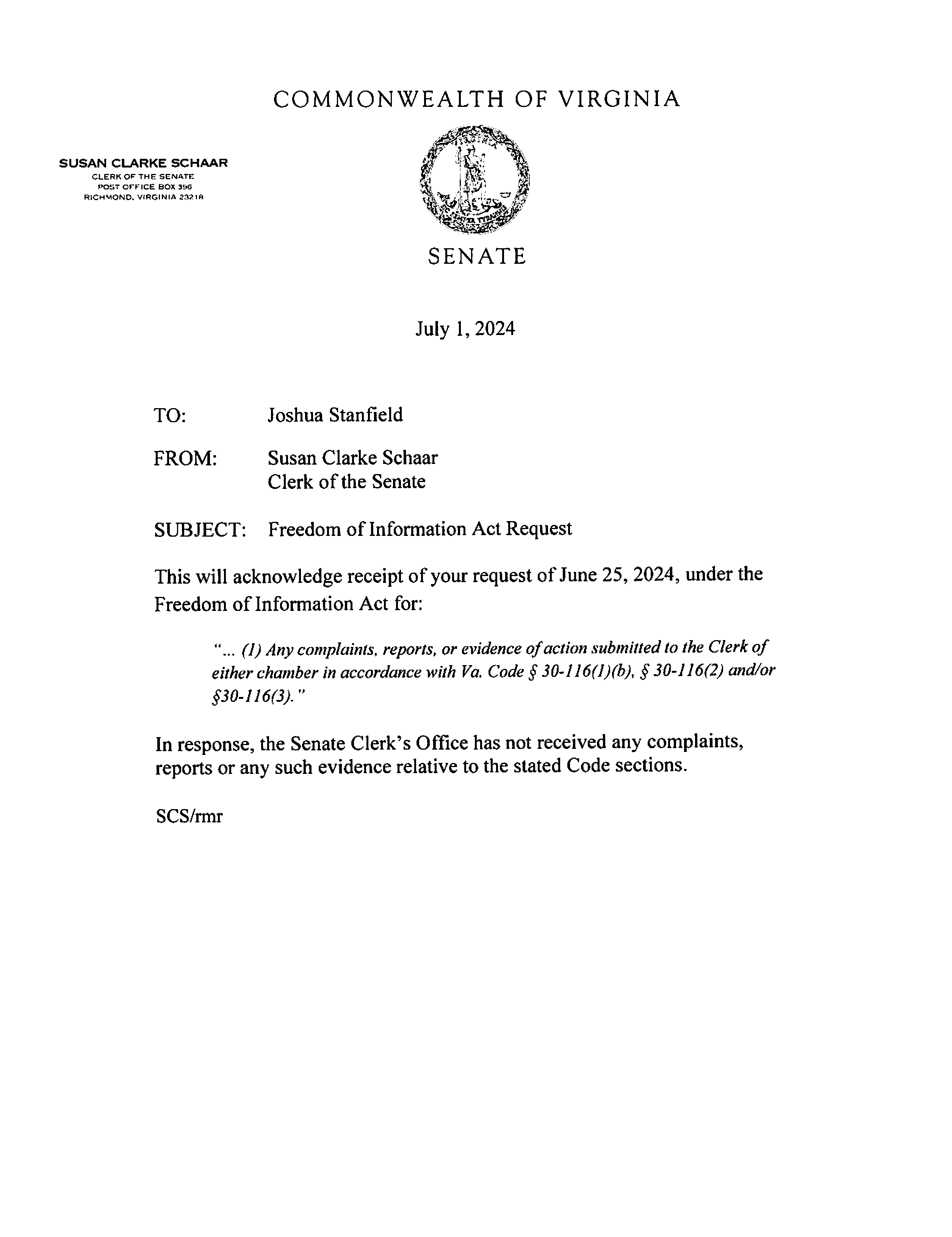
On June 25, 2024, I sent a FOIA request to both Senate Clerk Susan Schaar and House Clerk G. Paul Nardo seeking “[a]ny complaints, reports, or evidence of action submitted to the Clerk of either chamber in accordance with Va. Code § 30-116(1)(b), § 30-116(2) and/or § 30-116(3).”
On June 26, 2024, Nardo responded:
Since the Virginia General Assembly is a bicameral institution, I can only speak for the House regarding your request for information related to § 30-116(1)(b), § 30-116(2) and/or § 30-116(3) of the Code of Virginia.
For us, the only meeting that I am aware of was an organizational virtual meeting held on Tuesday, October 27, 2020 to elect a Chair and Vice Chair of the House Ethics Advisory Committee. The meeting lasted less than 10 minutes. The video is archived on the House Committee Streaming page.
I watched the video of the October 2020 meeting during which the Panel members did not discuss any complaints.
On July 1, 2024, Schaar responded in part that “the Senate Clerk’s Office has not received any complaints, reports or any such evidence relative to the stated Code sections.”
At this point, it seems clear that no ethics complaints have ever been advanced to either the Office of the Attorney General or to the clerks of either chamber.
How Many Complaints Have Been Filed?
On May 12, 2024, I sent a FOIA request to Stewart Petoe, Executive Director of the Virginia Conflict of Interest and Ethics Advisory Council, seeking:
(1) Copies of all Council annual reports from 2014-2023;
(2) Copies of all complaints filed pursuant to Va. Code § 30-114;
(3) Copies of any reports or analyses citing or analyzing the number of complaints filed.
On May 13, 2024, Petoe replied with links to the annual reports and the following response:
As for your second request, all complaints sent to the Ethics Council are confidential. Only if the Ethics Advisory Panel for the appropriate chamber (House or Senate) determines during its preliminary investigation that a complaint is not without merit are complaints made public. (The subject of a complaint can request a complaint be made public, at their discretion).
As for your third request, the Ethics Council does not analyze or record complaints sent to it, as complaints sent to it are confidential, as discussed above.
I replied on May 22, 2024: “As it pertains to the complaints, could you please tell me the volume of withheld records in accordance with Va. Code § 2.2-3704(B)(1)?”
On May 23, 2024, Petoe responded with an explanation:
The Ethics Council does not have any records responsive to your requests. Therefore, we are unable to provide the number you are asking for.
Allow me to explain. This is not a case where the Council has records and is keeping them confidential. We do not keep records related to complaints submitted pursuant to Virginia Code section 30-114.
Under Virginia Code section 30-114 (A), when the Council receives a complaint, it promptly sends the complaint to the Chair of the appropriate Panel and forwards a copy of the complaint to the subject of the complaint. At this point in the process, the Ethics Council's role is complete.
The Council does not keep a copy of the complaint and does not tally or record the number of complaints received. This is what I meant in my earlier email where I wrote "The Ethics Council does not analyze or record complaints sent to it."
As you can see, the Council's role is to serve as a "post office box" for complaints. When we receive a complaint, we pass it along and that completes our function.
The Panels themselves may be able to how provide information on how many complaints they receive, but I do not know if they keep this information, or if they do, for how long they keep this information, or if they are legally able to share this information with the public. As I mentioned in my earlier email, all complaints are confidential if they are deemed without merit during the preliminary investigation by the Panel.
I then asked Petoe who the custodian of the records was, and he responded by providing contact information for retired Judge Joe Canada and former Del. Margaret Vanderhye (D-McLean), who Petoe said were the chairs of the Senate and House Ethics Advisory Panels, respectively.
Next, I sent a FOIA request by email to Vanderhye and called Canada who requested I send a physical FOIA request to his P.O. box. On June 10, 2024, Vanderhye responded in part:
I am not aware of the number or nature of the Panel's ethics complaints beyond the very few we have received since I have been the Chair. In any case, we would not be able to release the information you request in any form since such a release would violate [§ 30-116]…
Without exception, the few complaints since I have been involved have been determined to be without merit. None of our elected officials has asked that they be released. I hope this information is responsive to your request and provides background for the basis of the policies and procedures we follow.
When I responded by asking for the volume of withheld records in accordance with Va. Code § 2.2-3704(B)(1) and asking who preceded her as chair, Vanderhye doubled down:
I do not know any of the names of the previous House Ethics Advisory Panel chairs, so I cannot help you with that information. Regarding your request for additional details about the ethics complaints filed in the past, I would point out that notwithstanding the provisions you mention, the code is very clear and unambiguous about ethics complaints deemed to be without merit:
...the Panel shall retain its records and findings in confidence unless the legislator under inquiry requests in writing that the records and findings be made public.
We cannot provide you additional information since the ethics complaints during my time as Chair were deemed to be without merit; the code prevents us from doing so, and no legislator has asked that the requirement for confidentiality be set aside. I trust this closes the matter.
Once Canada received my physical FOIA request, he emailed me a response on June 18, 2025 regarding the Senate panel:
I received your request for details about ethics complaints filed in the past, the code is very clear about ethics complaints deemed to [be] without merit. “the Panel shall retain its records and findings in confidence unless the legislator under inquiry requests in writing that the records and findings be made public.” While I was chair we had no complaints deemed with merit.
When I asked Canada for the volume of withheld complaints, he replied: “While I was Chairman we had three.”
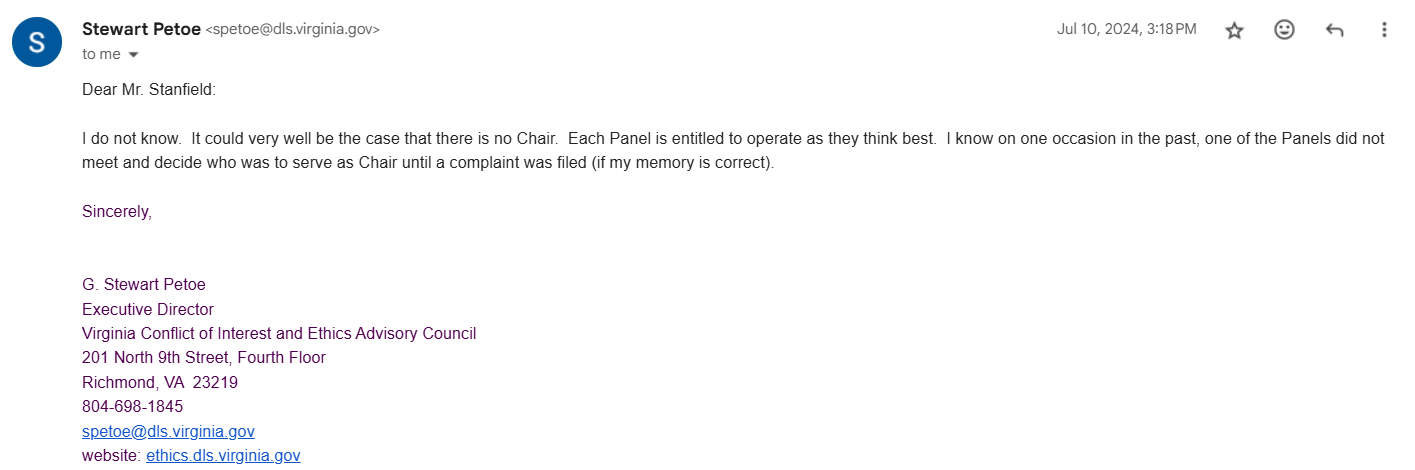
Although Petoe had indicated that Canada was the current chair of the Senate Ethics Advisory Panel, when I then asked Canada “the approximate dates of your tenure as Chair,” Canada replied “2011 to June 2023.” After some back and forth with Petoe and Canada, who insisted he ended his chairmanship in 2023, I asked Petoe if it were possible there was no chair of the Senate panel. He replied:
I do not know. It could very well be the case that there is no Chair. Each Panel is entitled to operate as they think best. I know on one occasion in the past, one of the Panels did not meet and decide who was to serve as Chair until a complaint was filed (if my memory is correct).
Based on these responses to my FOIA requests, at least as of last summer, it seems that no ethics complaints against members of the General Assembly have ever been advanced by either the Senate or House Ethics Advisory Panels to the Attorney General or to the clerk of either chamber.
While retired Judge Canada revealed three total complaints in his twelve-year tenure as chair of the Senate panel, all were deemed without merit. Former Del. Vanderhye recalled “very few” complaints on the House side, all of which were deemed without merit, but she refused to comply with the Virginia Freedom of Information Act and provide an exact number.
Mr. Petoe revealed that “the Council's role is to serve as a 'post office box’ for complaints,” that he didn’t know if the panels kept information about previous complaints, and that it wouldn’t be surprising if a panel lacked a chair.
And since the panels don’t issue public reports, as I’ll discuss in the next installment, we can’t track the number and fate of complaints over time. Instead, we’re expected to trust a process that has apparently never advanced a complaint from the shadows — and panels where complaints go to die their quiet deaths.
In the next installment, I’ll discuss the Office of the State Inspector General and compare its public reports to those of the Virginia Conflict of Interest and Ethics Advisory Council.